



In the early months of the first Trump Administration, the White House briefly appeared to purse a political realignment that challenged decades of Establishment Republican doctrine. At the center of that vision was Steve Bannon, the chief strategist who argued that “America First” should mean economic nationalism, strict immigration limits, trade confrontation with China, and a shift toward the American working class. For a moment, it looked like a populist nationalist movement had taken control of the Republican Party. But when Bannon left the White House in August 2017, that project began to fade. In the years that followed, influence inside the administration increasingly shifted toward establishment Republican priorities, raising a larger question that still defines Trump-era politics today: did the populist revolution actually happen, or did the Republican establishment ultimately absorb it?
Steve Bannon’s vision for the Trump movement was rooted in economic nationalism and populism rather than traditional Republican economic doctrine. He argued that American politics should prioritize the interests of American workers over global markets and the corporate elite.
In Bannon’s view, this meant protecting American industry and manufacturing through tariffs and industrial policy, limiting immigration to prevent lower wages for Americans, and confronting global trade systems that he believed gave American labor a disadvantage. He also emphasized reducing the influence of large corporations and financial interests in government while avoiding foreign wars and large-scale global intervention that drained American resources.
Bannon framed U.S. politics as a struggle between American workers and the elite that benefited heavily from globalization. Early Trump policies reflected this worldview, including the withdrawal from the Trans-Pacific Partnership and aggressive trade pressure on China, making the early administration appear to represent a break from the Republican establishment.
Steve Bannon’s departure from the White House in August 2017 marked a turning point in the Trump administration. After months of internal conflict with other senior advisors, Bannon left his role as chief strategist, and influence increasingly shifted towards figures like Jared Kushner, Gary Cohn, and other traditional Republican economic advisors. As this shift occurred, policy began to reflect more traditional GOP positions rather than Bannon’s populist nationalist agenda.
The clearest example of this was the Tax Cuts and Jobs Act, which dramatically reduced corporate tax rates. At the same time, the administration emphasized deregulation and pro-business policies strongly supported by Wall Street. Instead of the worker-focused nationalist economy Bannon envisioned, the administration increasingly resembled a pro-corporate Republican presidency.
Steve Bannon’s foreign policy worldview emphasized strategic restraint and a reduced role for the United States in prolonged overseas conflicts. He argued that American power should focus on rebuilding strength at home, avoiding long wars in the Middle East, and limiting large-scale global intervention. Just like with economic policy, over time, the administration moved closer to traditional Republican foreign policy priorities. In 2018, the United States withdrew from the Joint Comprehensive Plan of Action, escalating tensions with Iran and reimposing sanctions.
In 2020, a U.S. drone strike ordered by Donald Trump killed Iranian general Qasem Soleimani, sharply raising the risk of regional conflict. Today, the United States is engaged in a direct war with Iran following large-scale U.S. and Israeli strikes on Iranian military and nuclear targets, with Tehran retaliating against U.S. positions across the region. Taken together, this shows a clear movement away from the original nationalist restraint promised during Trump’s campaign and highlights a contradiction between early “America First” rhetoric and increasingly interventionist policies that followed.
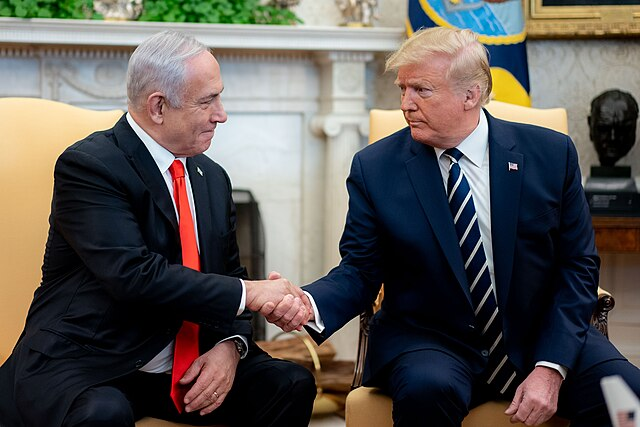
The populist movement that helped power Trump’s rise did not completely disappear after the early years of his presidency. Instead, it was gradually absorbed and redirected into the Republican establishment. This shift was also visible in political alliances. During the 2016 campaign Trump accused Marco Rubio of being a “puppet of the Adelson’s,” yet by 2024 Rubio served in Trump’s cabinet while Trump himself accepted major donations from the Adelson family. Trump continued to use populist rhetoric, anti-elite messaging, and hardline immigration politics to mobilize his base and maintain the identity of the “America First” movement.
Trump’s 2016 campaign represented a genuine ideological tear within the Republican Party. For a brief period, figures like Steve Bannon appeared to be reshaping the party around economic nationalism, immigration restriction, and a working-class populist coalition that challenged decades of establishment Republican doctrine. The early months of the administration suggested the possibility of a true political realignment. Yet as establishment figures regained influence inside the White House, policy increasingly returned to familiar establishment Republican priorities in economic and foreign policy. The populist revolution did not ultimately take control of the party. Instead, the Republican establishment proved more resilient, absorbing the movement’s energy while leaving it’s governing policy largely intact.










jc • Mar 16, 2026 at 1:10 pm
great article depicting the undeniable shift from the initial 2016 campaign.