Power in the Middle East did not shift overnight. It moved gradually, decision by decision, war by war, treaty by treaty, until one ally stood with unmatched military superiority. The question is not whether Israel became the region’s dominant power, but how American strategy helped make that possible.
The foundations of Israel were laid out decades before Israel declared independence. In 1917, Britain’s Balfour Declaration endorsed the establishment of a “national home for the Jewish people” in Palestine. This declaration was later embedded into the League of Nations Mandate in 1922. What began as an imperialist diplomacy soon became a reality. By the end of World War II, the question was no longer whether a Jewish state would emerge but when.
That backing came quickly. On May 14, 1948, the United States recognized Israel just eleven minutes after its declaration of independence. The decision was not without internal debate; State Department officials warned of potential regional instability. This is shown in the Foreign Relations of the United States archives. Within months of Israel’s declaration of independence, war broke out, and 700,000 Palestinians were displaced. Then came the United Nations General Assembly Resolution 194, which called for return or compensation, but it was never fully implemented, leaving the issue unresolved and creating regional tension.
In the years that followed, U.S.-Israel ties deepened, and Washington balanced support for Israel while prioritizing Cold War efforts. That balance shifted in June of 1967. In six days, Israel captured the West Bank, Gaza Strip, Sinai Peninsula, and Golan Heights, establishing itself as a regional power and shifting the regional power structure.
After 1967, the relationship evolved into a strategic partnership. U.S. military assistance grew significantly, and Israel became the largest recipient of American foreign aid. The war did more than just change borders; it set an alliance increasingly focused on preserving Israel’s military dominance in the region.
The alliance between Israel and the United States was tested almost immediately. On June 8, 1967, during the Six-Day War, Israeli forces attacked the USS Liberty, a U.S. Navy intelligence ship. 34 American servicemen were killed, and 171 were wounded. A U.S. Naval Court investigated the attack, and later declassified NSA files shed more light on the attack. Israel stated the strike was a case of mistaken identity; this conclusion was accepted by U.S. and Israeli officials.
Survivors of the attack, including Medal of Honor recipient Captain William McGonagle, later expressed doubts about the explanation, and debate over the attack persisted for decades. Despite the deaths of American sailors, the relationship between the U.S. and Israel continued to thrive.
Questions about the U.S.-Israeli relationship surfaced again in the late 1960s, this time in the United States. Attention turned to the Nuclear Materials and Equipment Corporation (NUMEC) in Apollo, Pennsylvania, where highly enriched uranium was reported missing during the 1960’s. Allegations emerged that some of this material may have been diverted to Israel’s nuclear program, though definitive proof was never publicly established.
A 1978 Government Accountability Office report examined the missing uranium and concluded that while significant quantities were unaccounted for, it could not determine whether diversion had occurred. Later, a declassified CIA memorandum from the late 1970’s said that some intelligence officials believed it was “quite possible” that highly enriched uranium from NUMEC had been diverted to Israel, but the assessment stated there was no definitive proof. Like the USS Liberty attack, the NUMEC allegations did not fracture the strong alliance between the U.S. and Israel.
In 1978, President Jimmy Carter brokered the Camp David Accords between Egypt and Israel, leading to the 1979 Egypt-Israel Peace Treaty. It was the first time an Arab state formally recognized Israel. This agreement did more than secure peace between two adversaries; it brought both countries closer into a long-term partnership with the United States. In the decades that followed, Egypt and Israel became two of the largest recipients of U.S. foreign aid. The accords reduced the likelihood of war between Israel and its most powerful neighbor, furthering Israel’s security interests.
Even as the alliance strengthened diplomatically and militarily, it faced yet another serious test in the mid 1980’s. In 1985, Jonathan Pollard, an American citizen and intelligence analyst for the U.S. Navy, was arrested for passing classified American intelligence to Israel. In 1987, he pleaded guilty to conspiracy to deliver national defense information to a foreign government and was sentenced to life imprisonment.
The case shocked Washington. It marked the most significant espionage breach between the United States and an allied nation. Israel initially denied that Pollard’s actions were part of an official operation, but later accepted responsibility and granted him Israeli citizenship in 1995. Pollard was released on parole in 2015 after serving 30 years in prison and was permitted to move to Israel in 2020. Despite the gravity of this espionage case, the U.S.-Israel relationship continued to grow stronger.
In 1996, a policy paper titled A Clean Break: A New Strategy for Securing the Realm was prepared for then Israeli Prime Minister Benjamin Netanyahu. The document argued that Israel should shift away from territorial concessions and instead pursue a strategy of regional realignment, including confronting regimes hostile towards Israel, such as Iraq.
Several of the paper’s authors would later hold influential positions in the George W. Bush administration. Richard Perle went on to chair the Defense Policy Board. Douglas Feith became Under Secretary of Defense for Policy. David Wurmser later served as an adviser to Vice President Dick Cheney. Elliot Abrams became Deputy National Security Advisor. While the memo was written for Israeli leadership, its authors would soon help shape U.S. foreign policy at a pivotal moment.
In 2003, the United States invaded Iraq, which resulted in the removal of Saddam Hussein from power. The operation fundamentally changed the balance of power in the Middle East. Iraq, which had once maintained one of the largest militaries in the region, was dismantled as a regional power. By eliminating one of Israel’s most significant historical adversaries and a major Arab military power, the war reduced the number of major military powers in the region.
The regional shift did not end with Iraq. In 2011, a NATO-backed intervention in Libya led to the removal of Muammar Gaddafi from power after the United Nations Security Council Resolutions 1973 authorized member states to take “all necessary measures” to protect civilians. Gaddafi’s fall removed another long-standing leader who had historically opposed Western and Israeli influence.
The same year, Syria descended into civil war. What had once been one of the region’s more formidable standing militaries was destroyed by internal conflict. The United States became involved through a combination of diplomatic pressure, economic sanctions, and, later, direct military action against ISIS beginning in 2014. Washington also provided training and support to certain Syrian opposition groups.
Although Bashar Al-Assad remained in power with backing from Russia and Iran, Syria’s ability to project military strength was severely weakened. Years of war eroded infrastructure, manpower, and central control, leaving the Syrian state diminished compared to its pre-2011 position.
As Arab military powers weakened, attention increasingly shifted towards Iran. In 2015, the Joint Comprehensive Plan of Action (JCPOA) was signed between Iran, the United States, and several world powers. Under the agreement, Iran agreed to cap uranium enrichment at 3.67 percent and submit to extensive International Atomic Energy Agency inspections in exchange for sanctions relief.
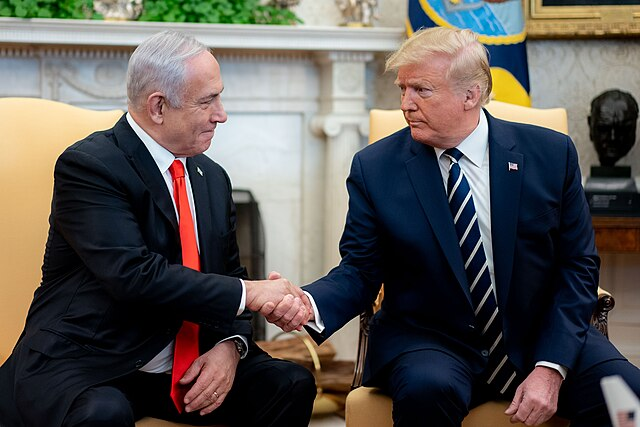
In May 2018, President Donald Trump announced that the United States would withdraw from the agreement and reimpose sanctions on Iran. The administration argued the deal failed to address Iran’s ballistic missile program and regional activities. Following the withdrawal, tensions between Washington and Tehran escalated, and Iran gradually expanded its enrichment levels beyond the limits set by the agreement. With Iraq dismantled, Libya fractured, Syria weakened, and Iran facing major economic pressure, the regional balance of power continued to change.
As pressure on Iran intensified, another major diplomatic shift unfolded. In 2020, the United States brokered a series of normalization agreements known as the Abraham Accords between Israel and several Arab states, including the United Arab Emirates, Bahrain, Morocco, and Sudan. For decades, formal recognition of Israel had largely been conditioned on resolving the Palestinian issue. The accords marked a diversion from that. The agreements did not end all regional tensions, but they normalized relationships between Israel and many Arab countries.
In the summer of 2025, U.S. forces carried out strikes on Iranian military and nuclear facilities. The Trump administration said its actions were intended to degrade Iran’s military capabilities and slow further nuclear advancement. More recently, a major joint U.S.-Israeli missile and airstrike campaign, described by Western officials as aimed at crippling Iran’s leadership and infrastructure, resulted in the death of Iran’s supreme leader, Ayatollah Ali Khamenei, who had led the Islamic Republic since 1989. Iranian state media acknowledged his death after a series of coordinated strikes on Tehran, marking a historic moment in the 2026 conflict and presenting how deeply U.S. and Israeli military efforts have weakened Iran.
Today, the landscape of the Middle East reflects decades of intervention by the United States and Israel. U.S. law formally commits Washington to preserving Israel’s Qualitative Military Edge (QME), ensuring that Israel maintains superior military capability over potential regional adversaries. Public Law 110-429 requires military advantage for Israel over its neighbors in the Middle East.
At the same time, Israel remains the largest recipient of U.S. foreign assistance since World War II, according to Congressional Research Service reports. This support has included advanced weapons systems, missile defense cooperation, such as funding for Iron Dome, and long-term security agreements that extend well into the future.
Everything taken together, the pattern is clear. Recognition in 1948, expanded military aid after 1967, diplomatic realignment through the Camp David and the Abraham Accords, regime changes that took down Israel’s regional adversaries, and legal guarantees of military superiority have all contributed to a Middle East in which Israel now holds unmatched strength.
The question is no longer whether the region changed; it clearly did. The deeper question is whether these outcomes were the byproduct of American security policy, or whether U.S. strategy consistently moved in a direction that ensured Israel would emerge as the region’s dominant power.