


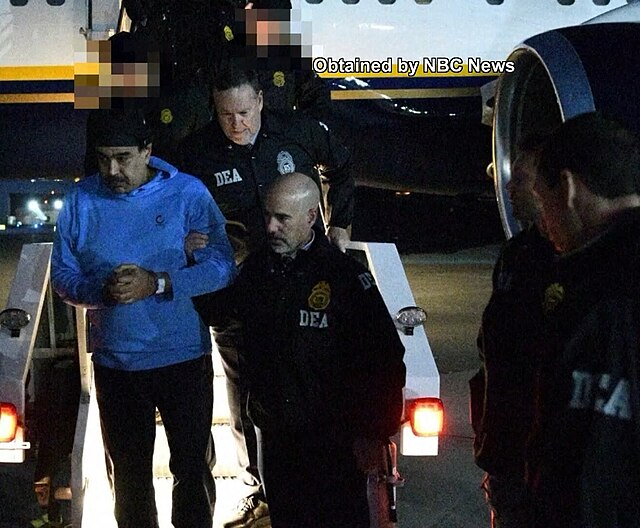
The idea that the United States can simply ignore Venezuela without consequences is no longer credible. I don’t support a full-scale invasion, and I don’t believe American troops need to be marching through Caracas. But after years of authoritarian rule, humanitarian collapse, and growing foreign influence, doing nothing is not a neutral position.
Strategic intervention short of boots on the ground is not only in America’s interest, but it may also be the best option left for the Venezuelan people. Inaction has failed to protect sovereignty or stability and has instead allowed suffering to worsen while American adversaries gain ground. The real question now is not whether the United States should be involved, but how it can act without repeating past mistakes.
There are several reasons why the United States intervention in Venezuela makes sense.
Under Nicolás Maduro and his predecessors, Venezuela’s institutions have steadily deteriorated. Elections have been widely criticized as unfair, political opponents have been jailed or silenced, and the government has consolidated power through oppression rather than consent. This political collapse has directly contributed to one of the worst humanitarian crises in the Western Hemisphere.
Since 2014, at least 6.8 million Venezuelans have fled the country, making it one of the largest displacement crises in the world. Millions more remain inside the country struggling with food shortages, a broken healthcare system, and extreme poverty. While exact death counts tied specifically to governance failure are debated, the scale of suffering and migration is not.
There is a moral argument for action when a government’s failures produce mass displacement and major instability. United States intervention could help create conditions for government stability and basic civil rights. Critics might say intervention violates sovereignty, but sovereignty loses its meaning when it’s used to protect oppression and widespread human suffering.
Recent events show that the United States understands that isolationism isn’t always in America’s best interest. Washington has restarted talks with top Venezuelan officials after Maduro’s capture, including Vice President Delcy Rodríguez, to regain leverage and shape what happens on the ground. Although diplomacy can work and has worked, sometimes intervention is needed to send a message to your adversaries.
Venezuela holds the largest proven oil reserves in the world, estimated at roughly 300 billion barrels. Despite this, oil production has collapsed due to corruption, mismanagement, and years of underinvestment. Output fell from more than 3 million barrels per day in the late 1990s to around 1.1 million barrels per day in recent years.
The United States played a major role in developing Venezuela’s oil infrastructure through decades of joint ventures and technical investment by American companies. Despite this, neither Venezuela nor America has benefited as the regime, under Hugo Chavez, nationalized assets, causing major United States oil companies to leave the country. This mismanagement of the country’s natural wealth led to the collapse of public services and a surge in inflation in Venezuela as well.
A stable Venezuela with a functioning energy sector would benefit both countries. Increased production could help stabilize Venezuela’s oil markets and strengthen U.S. energy security. This is not just an economic issue. It is a strategic one in an increasingly competitive global energy environment.
Leaving the world’s largest oil reserves in a failed state benefits criminal organizations and foreign adversaries far more than it benefits Venezuelans or Americans.
Over the past two decades, China and Russia have been expanding their influence across Latin America through loans and energy deals, with Venezuela serving as a key foothold. These relationships give adversaries economic and strategic leverage close to U.S. borders.
U.S. engagement, including deterrence short of a full-scale invasion, helps counter this expansion in a region long dominated by American hegemony. A firm stance in Venezuela signals that the United States is willing to protect its interests and those of its regional partners. Without real intervention, adversarial powers will continue to gain influence, strengthening authoritarian control and risking increased instability in the region.
Critics are right to warn that intervention comes with real human, economic, and moral risks. These risks deserve serious consideration. But in a world where authoritarian regimes create instability that spreads beyond their borders, inaction is not a neutral position.
“In any moment of decision, the best thing you can do is the right thing, the next best thing is the wrong thing, and the worst thing you can do is nothing,” as Theodore Roosevelt once said. Strategic intervention in Venezuela, focused on energy stability and regional security, is not imperialism; it is a response to a crisis that threatens both American interests and the lives of millions of Venezuelans.





jc • Feb 26, 2026 at 9:47 pm
very elegant take on the unique role America should be playing in the Western Hemisphere.