
Arapahoe Community College’s (ACC) Writers Studio hosted its annual Literary Festival on Saturday, Feb. 21st, to the largest group of attendees since the COVID-19 pandemic. Students, ACC staff, and speakers who work in the field gathered for a day of insightful learning, curious discourse, and, of course, Snarf’s Sandwiches.
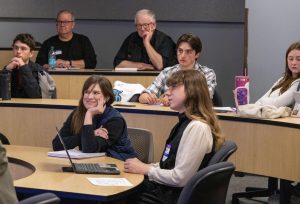
After poignant introductions from English Department Chair Scott Guenthner and Professor Jomil Ebro, attendees joined sessions featuring published authors who offered advice and workshops. “The most resilient form of curiosity is writing,” said Ebro during his inspirational speech. He then welcomed everyone, stressing the importance of community.
Teague Bohlen led one of two morning sessions, teaching “How Research Makes Us Better Writers,” in which Bohlen showed how conducting real-world research can greatly enhance fictional works, contrary to, perhaps, the perception that fiction must be completely made up. Bohlen went over how research in its various forms shaped his writing and how to approach these different methods. Bohlen emphasized that while going out to a library and reading up on a subject or place for your writing is valuable, it can be even more impactful to go out to historical societies or actual real-world locations related to your work. Bohlen was shocked by the large turnout for his lecture. “It’s too dry, I wouldn’t sign up myself,” Bohlen said with a laugh as he began his session.
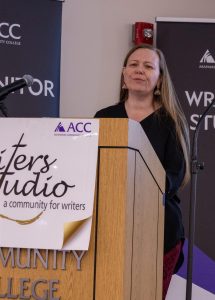
The other morning session was hosted by Brook Bhagat and focused on “Going Cold (or Hot on Nonsense),” in which she shared a useful strategy for any writer to use in emotional scenes in their own stories. By focusing purely on the facts and avoiding writing direct emotional cues in these scenes, the writer can let the reader fill in those gaps, which draws out more emotion. On the reverse, by focusing on more intense feelings in a more mundane setting, an author can draw out humor from a written piece.
After the morning sessions, attendees met in the Half Moon room for a catered lunch of Snarf’s Sandwiches. After lunch, each author read excerpts from their recent work, wowing the audience with their literary skills.
The afternoon sessions were kicked off by Erika T. Wurth, who took an industry approach to her lecture “Structuring Your Novel: Concrete Tactics to Finishing That Novel.” Wurth focused on structure and plot because they are not taught at the undergraduate and graduate levels. She introduced the three-act structure, which details where things should take place in your novel; one such well-known three-act structure is the hero’s journey. Wurth discussed useful tools students could use to apply novel techniques, drawing on Jessica Brody’s “Save the Cat! Write a Novel” as an example. Wurth wrapped up this session with some advice about getting published and finding agents.
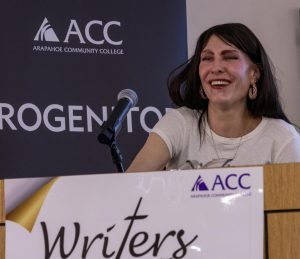
The last Speaker of the day, Steven Dunn, offered a unique approach to worldbuilding in his workshop-heavy session, “World-building and Setting Through Rap Lyrics.” Dunn approached the subject by showing how rappers build complex worlds within just a few lines of lyrics, using “N.Y. State of Mind Part II” by Nas as an exemplar to deconstruct and use in focused prompts. Dunn taught students how to appreciate the finer details of writing by utilizing techniques such as montage speed (slow down or speed up), movement in sensory description, and distance with a focus on horizontal vs vertical imagery.
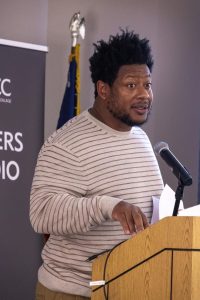
The festival appropriately concluded with brief readings from attendees, who were invited to share their work on an open mic. Approximately ten writers stepped up to embrace the warm energy of the remaining crowd.
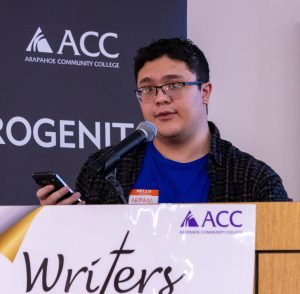
This year’s Literary Festival offered a wide range of subjects to explore. Writers Studio co-Coordinators, Ebro and Professor Rachel Newlon, along with various volunteers from the English Department, hosted an inclusive, engaging, and memorable event attended by students, alum, and community members.
Writers left with new information on the craft and a renewed sense of literary exploration. “The best key to the prison of fear I know is curiosity,” said Gunther of the writers who gathered to learn.